
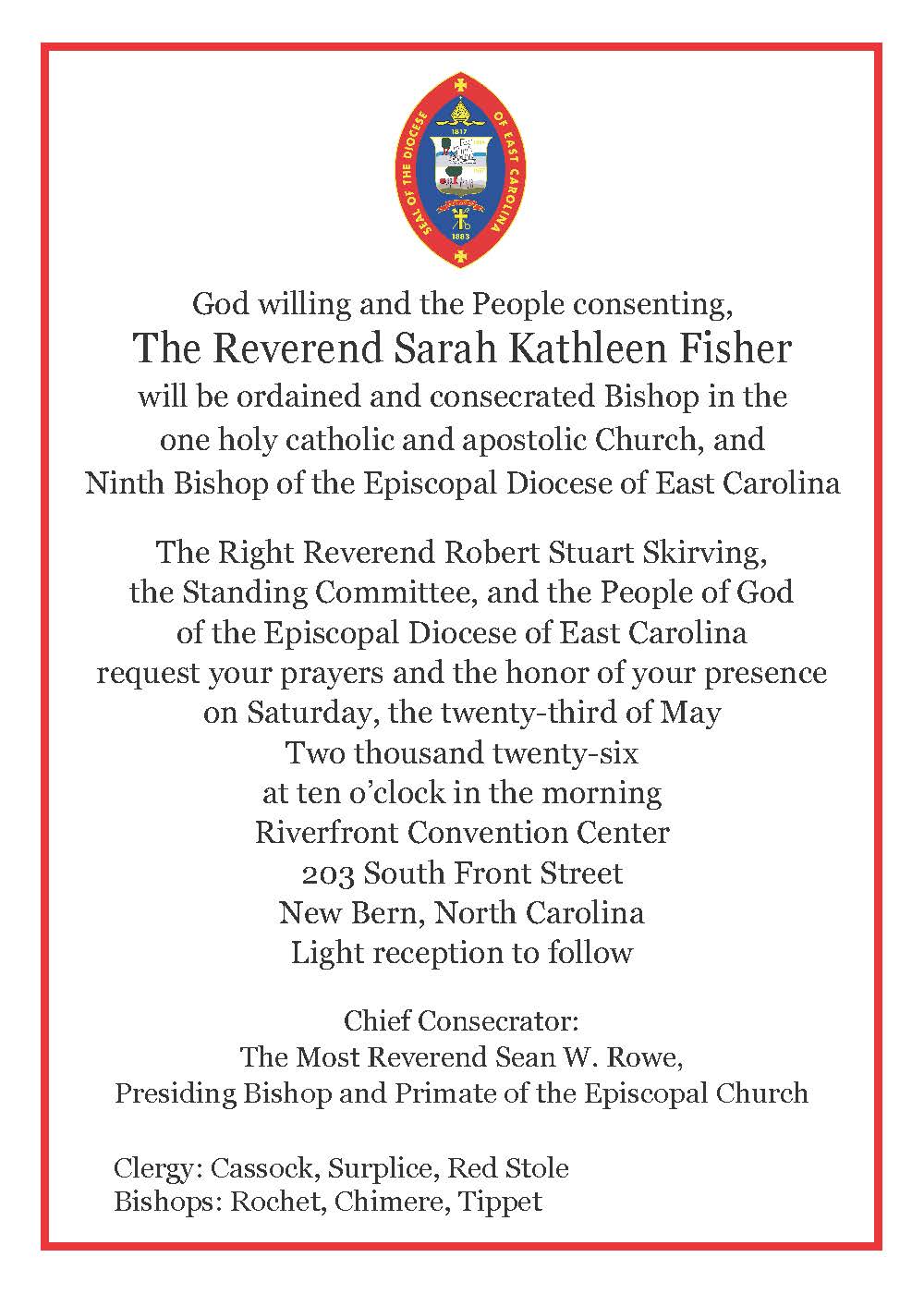
The Ordination of Our Ninth Bishop
YouTube Livestream
A Prayer for Bishop Transition
O God whose love never fails, and whose Presence is eternal; Be with us, the Diocese of East Carolina, during this time of sacred transition.
We thank you for your steadfast love made known through the faithful ministry of our Bishop Rob. Grant him and his wife Sandy your peace in this time of closure and joy for what is to come.
We thank you for calling your servant Sarah to serve as bishop of this diocese. With grateful hearts, prepare us to welcome her and her wife Mandy among us, trusting in your Spirit who has guided her to this new season of ministry.
As we cross from what has been into what will be, keep us rooted in your abiding presence. Knit us together in unity and love, that we may share in Christ’s mission and bear faithful witness to the hope we have in him.
– Amen.
Location and Venue Information
As we get closer to the date of the Ordination and Consecration of Bishop-Elect Fisher, we will be posting relevant links and resources to this page. Be sure to check back often for updates!
As you start to plan your time in New Bern, be sure to visit the City of New Bern website for information about the city! You can also learn more about our venue at the Riverfront Convention Center website.
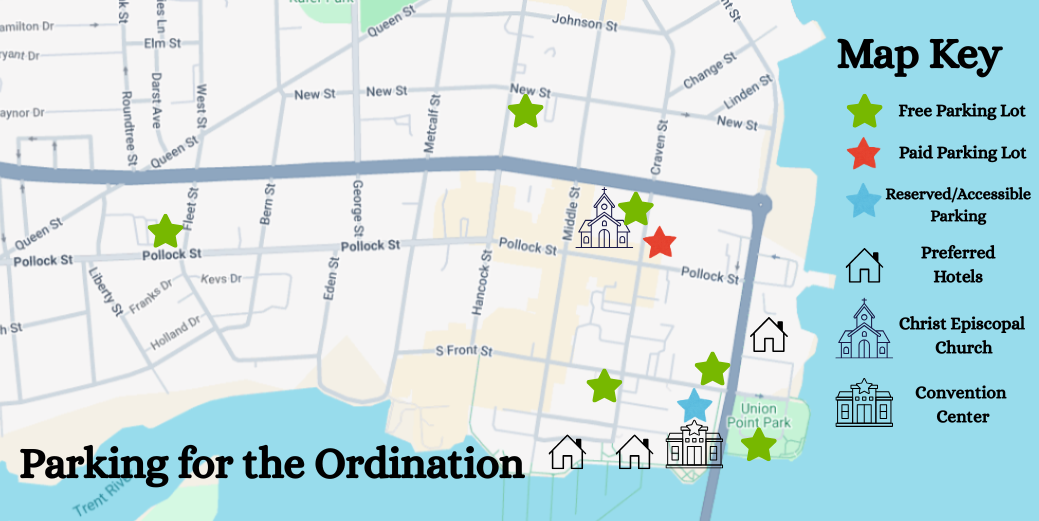
Event Accommodations
Gifts for Bishop-Elect Sarah Fisher
One of the ways we welcome Bishop-elect Sarah Fisher is by presenting her with the Gifts of Office at the Ordination. Your generosity will help provide liturgical vestments and symbols of office, ensuring a warm welcome to the Diocese of East Carolina. We are asking anyone who is willing to make a donation towards her gifts to click here to make their gift and/or find instructions for paying by check.
You can give towards a specific gift or make a general donation. If you like to discuss a specific gift, please contact the Bishop Transition Committee or Mary Duane Hale directly. Any gifts made above the cost of gifts will be placed in Bishop-elect Fisher’s Discretionary Fund.
All of Bishop-elect Fisher’s vestments and gifts are being hand made. Below are some examples of vestments she will be receiving.

Rochet, Chimere and Bishop's Scarf
The rochet and chimere are worn by bishops as “choir dress” in non-Eucharistic liturgies such as the Daily Office or in a diocese where a cope and mitre are not preferred. “Choir dress” is traditionally worn by clergy in public prayer when they are not part of the altar party and are seated in the choir. For example, if they are preaching but not presiding. The scarf will have the Diocesan Seal on one side and The Episcopal Church seal on the other.

Bishop's Ring
Since the Middle Ages, each new bishop has received an episcopal ring as a sign of office. Like a wedding ring, an Episcopal Ring is a symbol of the bishop's faithfulness to God and the Church. The ring is used as an official seal on documents that call for the bishop to affix a seal in wax. Each visiting bishop impressed a wax seal on the bishop’s ordination certificate before the liturgy began.

Cope
The cope is a long mantle or cloak, open in the front and fastened with a band or clasp across the chest. From the Latin capa, meaning cape, it may be worn by any rank of the clergy on festival occasions. Bishop-elect Sarah will be receiving a red cope and mitre.

Mitre
The mitre is perhaps the most distinctive symbol of the bishop. The shape of the mitre is reminiscent of the tongues of fire that rested on the heads of the Apostles gathered in the upper room on the Day of Pentecost. Attached to the back of the mitre are two strips of cloth, called fanons, which are symbolic of the spirit and authority of the Old and New Testaments. The mitre is a reminder of a bishop’s apostolic authority and ministry of “proclaiming Christ’s resurrection and interpreting the Gospel” to the Church and to the world. Bishop-elect Fisher will be receiving a red and white mitre.

Pectoral Cross
A cross, typically of silver or gold, suspended by a chain around the neck. The cross hangs at about the breastbone or pectoral muscles of the wearer. It may be adorned with jewels. It was used by the Pope in the thirteenth century and came into general use by bishops and certain other prelates in the sixteenth century. Bishops now often wear an ornate pectoral cross as an episcopal insignia. Some priests wear a simple pectoral cross.